 Instrument
Reference Library
The Pearson Finger-Type Indicator
Ivar L. Pearson — Los Angeles / MAGICO, North Hollywood
Where Pearson fits
Ivar L. Pearson of Los Angeles filed his indicator patent in September 1941 — weeks before Pearl Harbor — into the middle of the Southern California aircraft boom. The instrument superficially resembles the Lowe/Starrett Last Word, but the movement is a fourth, unduplicated answer to the direction problem: a knife-edge rectifier that reads the same way regardless of which direction the feeler is deflected. Production ran under Pearson's own name (units marked "I.L. Pearson, L.A. Calif." circulated into the early 1960s), with manufacture and advertising at some point passing to M. & G. Inst. Co., later MAGICO, of North Hollywood — a maker about which almost nothing is documented.
The four solutions to the direction problem — where Pearson's branch sits in the family taxonomy:
| Maker / family | Mechanism | Directional behavior |
|---|---|---|
| Lowe / Starrett Last Word | helix & jewel | Manual — reversing lever selects direction (single-direction on earliest models) |
| Gladwin / Winters | dual diverging arms | Automatic, bidirectional — one arm drives per direction |
| Swiss (Tesatast/BesTest, Interapid, Compac, Alina) | gear train | Automatic, bidirectional |
| Pearson | knife-edge rectifier | Automatic, unidirectional — plus or minus deflection both read the same way |
The one known Pearson patent
A targeted search found no further indicator patents under Ivar L. Pearson — the count below is stated as known, not exhaustive (a lesson encoded after REF-PAT-711 REV A's premature "complete").
What it covers
- The rectifier: the feeler is carried in a pivoting trunnion block whose concave face engages a knife edge on the driving trunnion from both sides of its pivot — whichever way the feeler deflects from neutral, the trunnion rotates the same direction. The spec states the purpose plainly: whether the error is plus or minus, "the indicator always reads in one direction and the user need not stop and add or subtract."
- Long range, short train: where contemporary finger indicators read 10–12 thousandths, Pearson's lever geometry registers 50–75 thousandths through only two gears — accuracy with cheap construction, no long multiplication train to wear.
- Shop-floor ergonomics claims: a horizontally-read dial oriented for lathe and mill mounting, and a ball-detent indexable feeler that clicks between angular positions rather than relying on a friction joint.
Documents
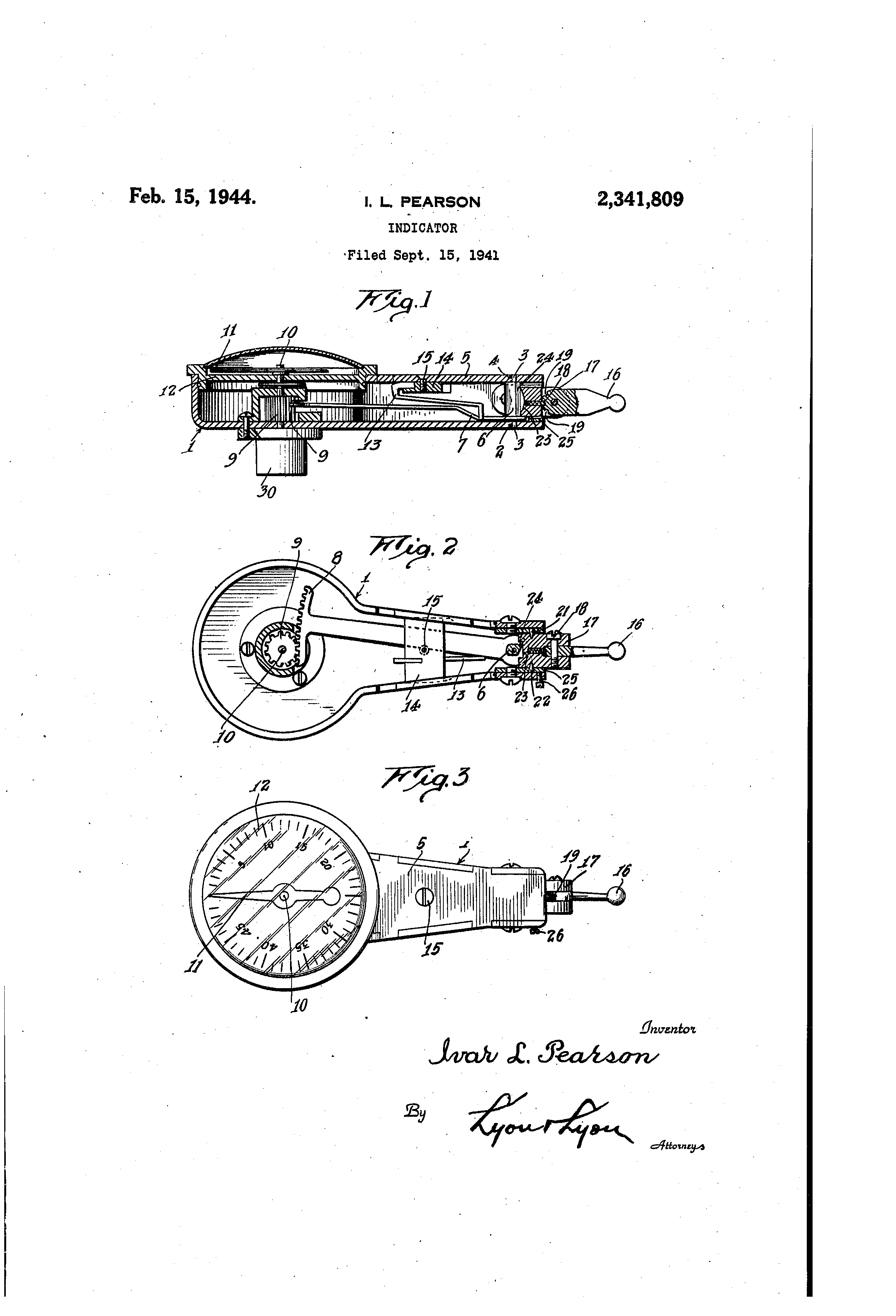 Click to zoom
Marking → window (thin record — treat as provisional)
| Marking / configuration | Window | Reading |
|---|---|---|
| "I.L. Pearson, L.A. Calif." (or similar Pearson mark) | c.1944–1960s | Pearson-era production; attested in use to c.1963. |
| Pearson-branded dial AND box; box: 12940 Saticoy St., North Hollywood, Calif. (no ZIP), tel. POplar 5-0422; Pat. No. 2,341,809 (last digits corroded; reading probable) | c.1950s | REFERENCE EXAMPLE (this collection). Two-letter exchange + zone-less address = pre-1963, consistent with 1950s boxing. First physical evidence tying the Pearson brand to a North Hollywood industrial address — the neighborhood attributed to M. & G. Inst. Co. / MAGICO. Original building no longer stands (site redeveloped 1990). Mechanism fingerprint: not yet recorded. |
| "M. & G. Inst. Co." marking | undated | The pre-MAGICO company name; presumed later than first Pearson production. Sequence undocumented. |
| "MAGICO" (North Hollywood) marking | undated | Later trade name of M. & G. Follows the Inst. Co. marking by definition; absolute dates unknown. |
| Unidirectional needle response, both deflections | — | Mechanism fingerprint. Confirms a Pearson movement regardless of dial marking or re-branding. |
Open research questions: whether 12940 Saticoy St. was Pearson’s own plant or the M.&G./MAGICO facility boxing Pearson-branded product (the reference example proves coexistence of brand and address, not which entity operated there); how "I.L. Pearson, L.A. Calif."-marked units relate to North Hollywood-boxed ones; the Pearson→M.&G./MAGICO handoff date and terms; whether MAGICO-marked examples differ mechanically; the fate of the operation after patent expiry; any trade-literature advertising (period industrial directories for the POplar exchange and Saticoy corridor are now the sharpest hunting ground). Any marked example crossing the bench should be photographed dial/back/mechanism — every data point here is publishable.
Source register
- USPTO full text via Google Patents: US 2,341,809 (Ivar L. Pearson, Los Angeles; filed 1941-09-15, granted 1944-02-15) — mechanism, range, and purpose statements per specification.
- Google Patents citation index — cited by Mitutoyo US 4,428,121-family (1981), Mitutoyo swing-magnifying patent (1996), Mitutoyo DE filing (2019).
- Garage Journal wanted thread — product names, Last Word resemblance, M. & G. Inst. Co. / MAGICO North Hollywood attribution, collector demand with finder's fee.
- Practical Machinist lens-replacement thread — "I.L. Pearson, L.A. Calif." marking, circa-1963 unit, company untraceable today.
- Negative search result (2026-07-08): no additional Ivar L. Pearson indicator patents surfaced; count stated as known, not exhaustive.
- Reference example (this collection, documented 2026-07-08): Pearson-branded instrument and original box; box label 12940 Saticoy St., North Hollywood, Calif., POplar 5-0422; patent line read as 2,341,809 with final digits corrosion-degraded (reading probable, not certain). Site of address verified as redeveloped (1990 storage facility) — the box label is likely among the only surviving records of the address's industrial occupant.
Related documents
Links resolve within the reference/ tree (dossiers/<family>/ layout). Cross-references also carried in each JSON sidecar as relatedDocs.